

What a NERC Level 3 Alert Means for Data Center Owners
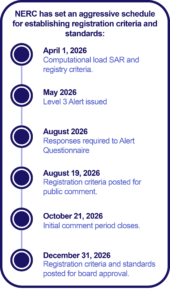
When NERC formally notified FERC on March 20, 2026 that data centers pose an emerging risk to bulk power system reliability, it marked a turning point: computational loads were no longer being treated as ordinary customers. NERC has now issued its Level 3 Essential Action Alert for computational loads – and with it, documented accountability expectations are moving from forecast to active implementation for grid-connected data center facilities.
Why Data Center Owners Should Pay Attention Now
NERC has issued the Level 3 Alert while continuing to advance new registration categories specific to computational loads, including data centers. Becoming a registered NERC entity means the organization is formally subject to mandatory reliability standards applicable to the Bulk Power System (BPS). These standards are enforceable, auditable, and carry financial consequences if violated. Utilities and registered entities are now being pushed to collect, validate, and maintain specific data from computational load facilities during interconnection and throughout their operational lifecycle. Data center owners should now be prepared for utilities to request detailed information on load composition (IT vs. non-IT), dynamic characteristics, protection settings, ramp rates, on-site generation, and facility use type (AI training, crypto mining, or traditional compute). Facilities that cannot provide this data may face delays or complications in interconnection and commissioning.
The Big Shift: From “Customer Load” to “Reliability-Relevant Facility”
Historically, data center projects were treated primarily as large commercial or industrial customers. The issued Level 3 Alert confirms a different posture.
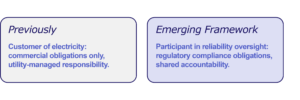
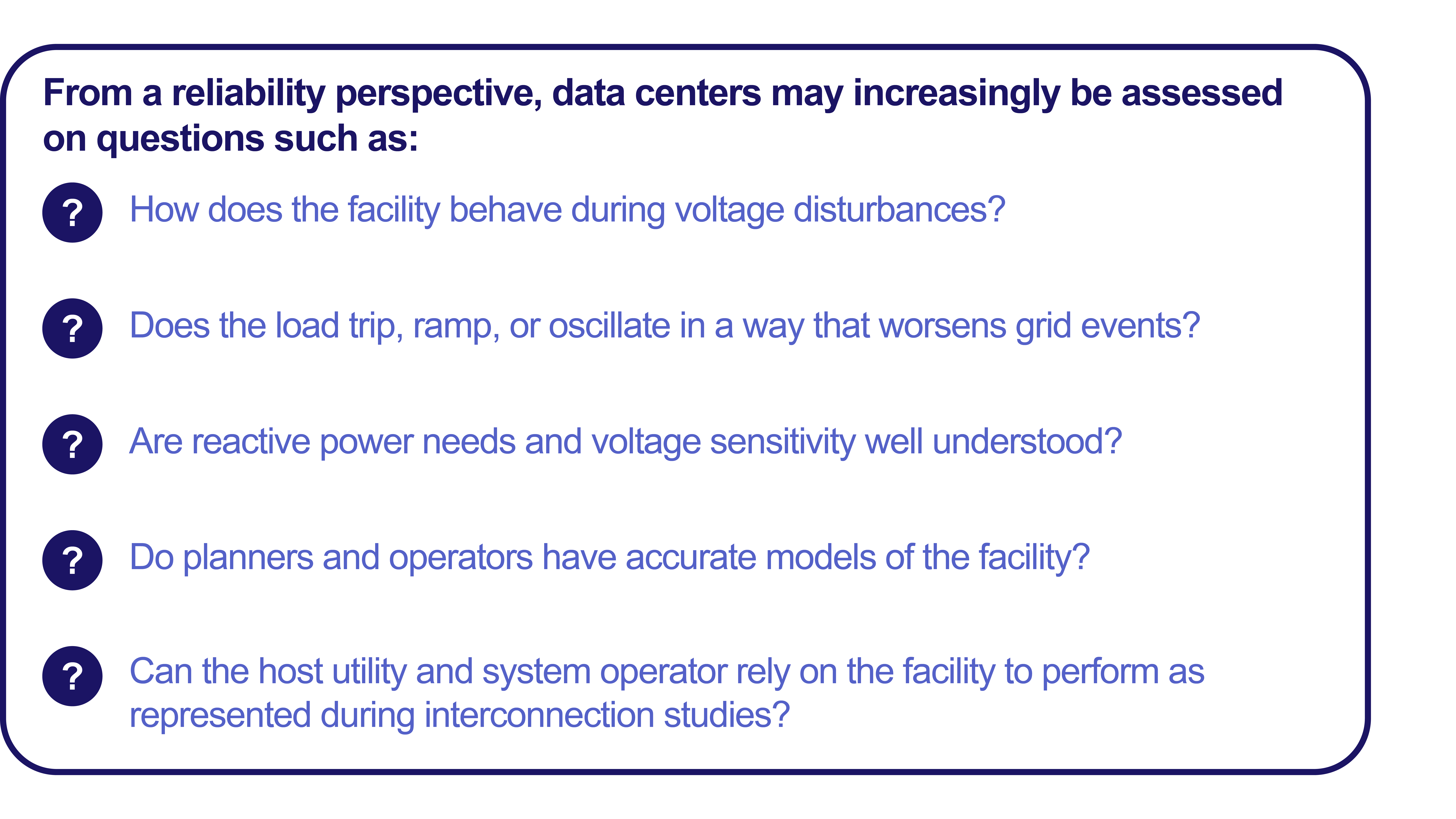
For data center owners, this means electrical design choices, control philosophies, and operational practices are becoming regulatory and reliability issues, not just internal engineering decisions.
Companies with large development pipelines should monitor NERC’s Large Loads Action Plan closely, respond to the Level 3 Alert’s near-term expectations where applicable, and assume that utility and reliability requirements may tighten further through 2026 and 2027.
What Data Center Companies Can Do Now
- Treat power system behavior as a strategic issue, not simply an internal engineering matter.
- Inventory where facility behavior may be poorly documented (dynamic performance, reactive power, protection settings).
- Expect utilities to ask harder and more formalized questions regarding load composition, controls, ride-through behavior, instrumentation, commissioning, protection, and operating scenarios.
- Reassess project schedules and contingencies to account for more iterative study and testing requirements.
- Prepare for standards evolution: monitor NERC’s action plan and plan for requirements to tighten through 2027.
- Understand that repurposing a computational load facility — for example, converting from traditional data storage to AI training — may now trigger a utility review of protection schemes, stability limits, and interconnection requirements.
- Prepare for formal commissioning processes that include full load and no-load testing, voltage change tests, and coordinated checklists with your serving utility before energization.
How Danovo Energy Solutions Helps Hyperscalers respond
- Assessing potential sites and interconnection strategy based on NERC’s issued Level 3 Alert and evolving computational load requirements.
- Modeling, planning, and refining phasor model representation of loads for system planning.
- Validation of dynamic and EMT performance, including laboratory testing (RTDS) of controls and power supply hardware. (View our modeling and validation project)
- Commissioning and testing new facilities to verify reliability performance and NERC compliance.
- De-risking behind-the-meter and advanced power architectures before deployment. (View our mitigation architecture project)
- Assessing whether existing facilities may meet proposed computational load registration criteria and supporting preparation for future registration processes with NERC Regional Entities (SERC, WECC, MRO, etc.).
- Developing compliance-ready processes specific to NERC as a regulatory entity.
- Preparing and organizing the data package utilities will formally request during interconnection — including load composition, dynamic parameters, protection settings, and on-site generation information.
- Supporting facilities through formal pre-energization commissioning checklists, including SCADA verification, protection system testing, and coordination with Reliability Coordinators and Balancing Authorities.
In Summary
With the Level 3 Alert now issued, the question is no longer whether computational loads will face greater reliability expectations — it is how quickly each organization can document, demonstrate, and defend its compliance posture to the utilities, planners, operators, and regulators it depends on.
About the Author
Eric John, Executive Advisor, Sr. Director Transmission Technology Solutions, has 30 years of experience working with electric utility owners in the planning, specification, and application of technology in power systems. Eric studied Electric Power Engineering at Renssalaer Polytechnic Institute and earned his MBA from Duke University.
He currently leads a specialized team that provides technical and commercial oversight for the implementation of technology solutions such as STATCOM, BESS, and other ATTs that are applied to increase transmission capacity without building new transmission lines or substations. He also co-leads a cross-functional consulting services team at Danovo Energy Solutions focused on data center applications.
His work with Danovo Energy Solutions also includes automation of engineering processes with software solutions and the commercial development of new hardware concepts for BESS and microgrids.

Contact us to connect with a technical expert about NERC compliance