

Mitigation Architecture for AI Computational Load Instability
Selecting the right mitigation architecture for ai computational load instability
Objective
Evaluate oscillatory and stability risks from AI-driven, power-electronic-dominated load on conventional generation systems and identify mitigation architectures capable of managing fast load dynamics and negative damping that conventional generation cannot address.
Approach
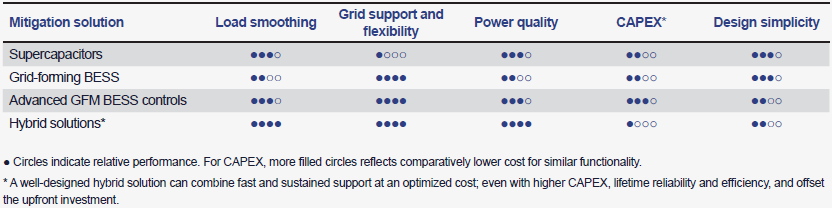
- Evaluate four mitigation solution architectures across five performance dimensions to identify the optimal configuration for managing AI load instability.
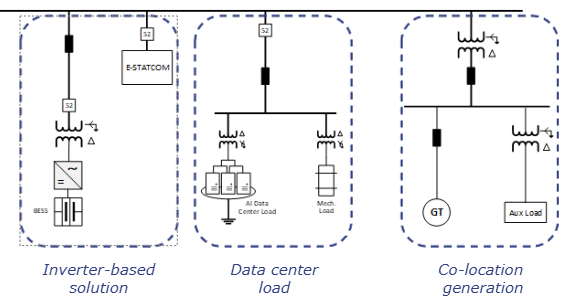
- Architectures evaluated include inverter-based solutions (E-STATCOM, BESS with grid-forming controls), co-location generation (gas turbine with auxiliary load), and hybrid configurations combining multiple technologies.
Results
No single solution optimizes across all performance dimensions — hybrid architectures deliver the highest technical performance, combining fast and sustained grid support, though they carry greater upfront complexity and cost. Where CAPEX is constrained, advanced GFM BESS controls provide the strongest balanced performance at moderate cost. Supercapacitors remain a viable, lower-complexity option where load smoothing and power quality are the dominant requirements and broader grid support needs are limited. Solution selection must ultimately be driven by site-specific performance requirements, CAPEX constraints, and operational risk tolerance.
Contact us to learn more about AI computational load instability