


NERC Level 3 Alert: Computational Load Requirements for Utilities
The United States is entering a period of unprecedented load growth, driven primarily by large data center developments supporting AI and digital infrastructure. This growth is occurring on timelines that often outpace traditional planning, interconnection, and regulatory processes. NERC’s imminent Level 3 Alert on Computational Load Modeling, Studies, Instrumentation, Commissioning, Operations, Protection, and Control – expected May 2026 – represents a fundamental shift in how computational loads are treated within the bulk power system.
What Triggered the Alert?
Recent events have demonstrated that large data center loads are active, dynamic system elements whose behavior can materially impact grid reliability. Industry experience with inverter-based resources (IBRs) has already shown that gaps between modeled and actual performance create significant reliability risks. Large data center loads, with their high concentrations of power electronics and controlled equipment, introduce similar concerns:
- Rapid, coordinated load drops or increases
- Sensitivity to voltage and frequency disturbances
- Limited utility visibility into controls and operational behavior
- Gaps in modeling, validation, and performance requirements
NERC formed the Large Load Task Force (LLTF) in 2024 to evaluate reliability impacts of these emerging loads. Since inception, the team has published multiple white papers, supported a Level 2 Alert, and convened a technical conference in February 2026. In parallel with these activities, NERC has posted draft registry criteria and a Standard Authorization Request (SAR) for computational load, signaling that voluntary interim actions are expected to transition to mandatory standards. Clear expectations are for NERC to issue a Level 3 Alert in May 2026.
Why a Level 3 Alert, and Why Now?

A Level 3 Alert signals that reliability risks are immediate and material, that industry-wide action cannot wait for formal standards development, and that entities are expected to implement interim measures with documented accountability. The near-term expectation is that utilities, planners, and operators will act with incomplete but evolving regulatory clarity and prepare for forthcoming mandatory requirements.
Four Priority Action Areas for Utilities
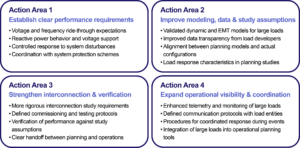
These four areas — establishing performance requirements, improving modeling and data assumptions, strengthening interconnection and verification, and expanding operational visibility — reflect the core of what utilities need to address ahead of the alert.
Implementation Timeline
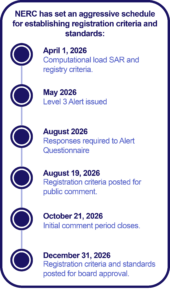
NERC’s accelerated action plan outlines a compressed schedule, a rapid progression from guidance to enforceable standards, with stakeholder engagement occurring throughout.
How Danovo Energy Solutions Can Support Utilities in Preparation for New NERC Compliance Requirements
Danovo Energy Solutions has direct experience with many of the largest data center load-serving IOUs in the US, providing end-to-end support from planning through implementation:
- Modeling, planning, and refining phasor model representation of loads for system planning and facility-level EMT representation of computational loads
- Validation of dynamic and EMT performance, including laboratory testing (RTDS) at the component, controls, and power supply hardware level
- Implementation of technology solutions (e.g., STATCOM, BESS) to mitigate findings related to facility behavior
- Review of facility commissioning and test results to verify reliability performance and NERC compliance
- Design and implementation of continuous performance monitoring and automated compliance analysis and reporting following disturbances
- Developing compliance-ready processes specific to NERC as a regulatory entity
- Supporting engagement with hyperscalers during study, commissioning, and early operation phases
In Summary
The imminent NERC Level 3 Alert signals an urgent shift in how large data center loads are planned, modeled, and integrated into the bulk power system. Utilities and reliability stakeholders are expected to act now, implementing interim measures, improving visibility, and preparing for accelerated compliance requirements despite evolving regulatory clarity. Proactive action across performance standards, modeling, interconnection, and operations will be critical to maintaining grid reliability and reducing future compliance risk.
About the Author
Eric John, Executive Advisor, Sr. Director Transmission Technology Solutions, has 30 years of experience working with electric utility owners in the planning, specification, and application of technology in power systems. Eric studied Electric Power Engineering at Renssalaer Polytechnic Institute and earned his MBA from Duke University.
He currently leads a specialized team that provides technical and commercial oversight for the implementation of technology solutions such as STATCOM, BESS, and other ATTs that are applied to increase transmission capacity without building new transmission lines or substations. He also co-leads a cross-functional consulting services team at Danovo Energy Solutions focused on data center applications.
His work with Danovo Energy Solutions also includes automation of engineering processes with software solutions and the commercial development of new hardware concepts for BESS and microgrids.

Contact us to connect with a technical expert on NERC compliance