

Three decades of grid disturbances point to the same finding: the engineering problems were understood well before the events that made them mandatory to fix. From the 1996 Western breakups through the 2025 Iberian blackout to this summer's data center disconnections in PJM, the pattern holds: the modeling gap is identified, then closed, then the standards catch up years later. The open question for asset owners is not whether these risks are known, but whether they're already sitting in a study report, unacted on.
Thirty years ago, this summer, the Western Interconnection came apart twice in six weeks. Neither event could be reproduced in the planning models of the day. That is the part worth remembering now.
July 2, 1996
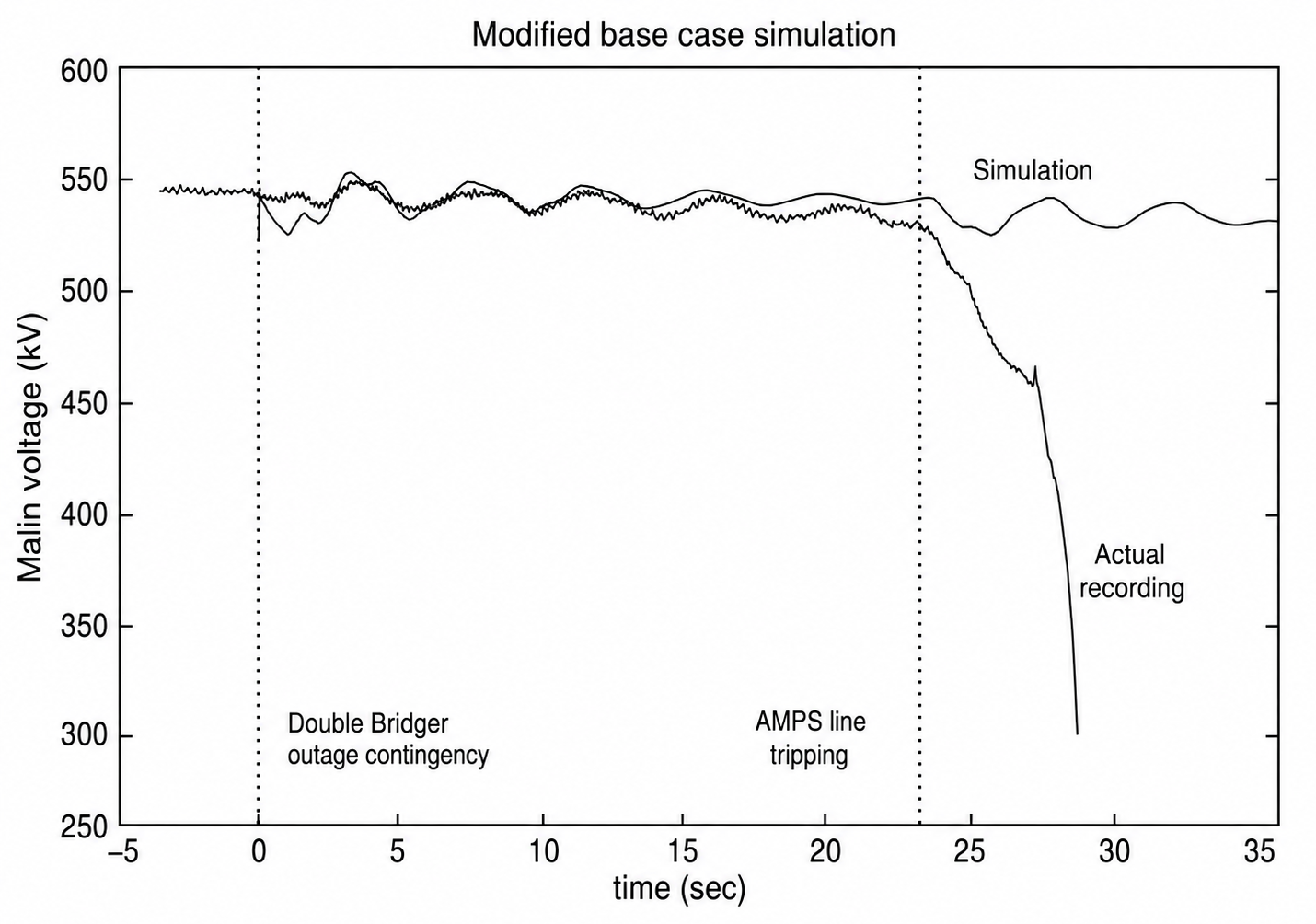
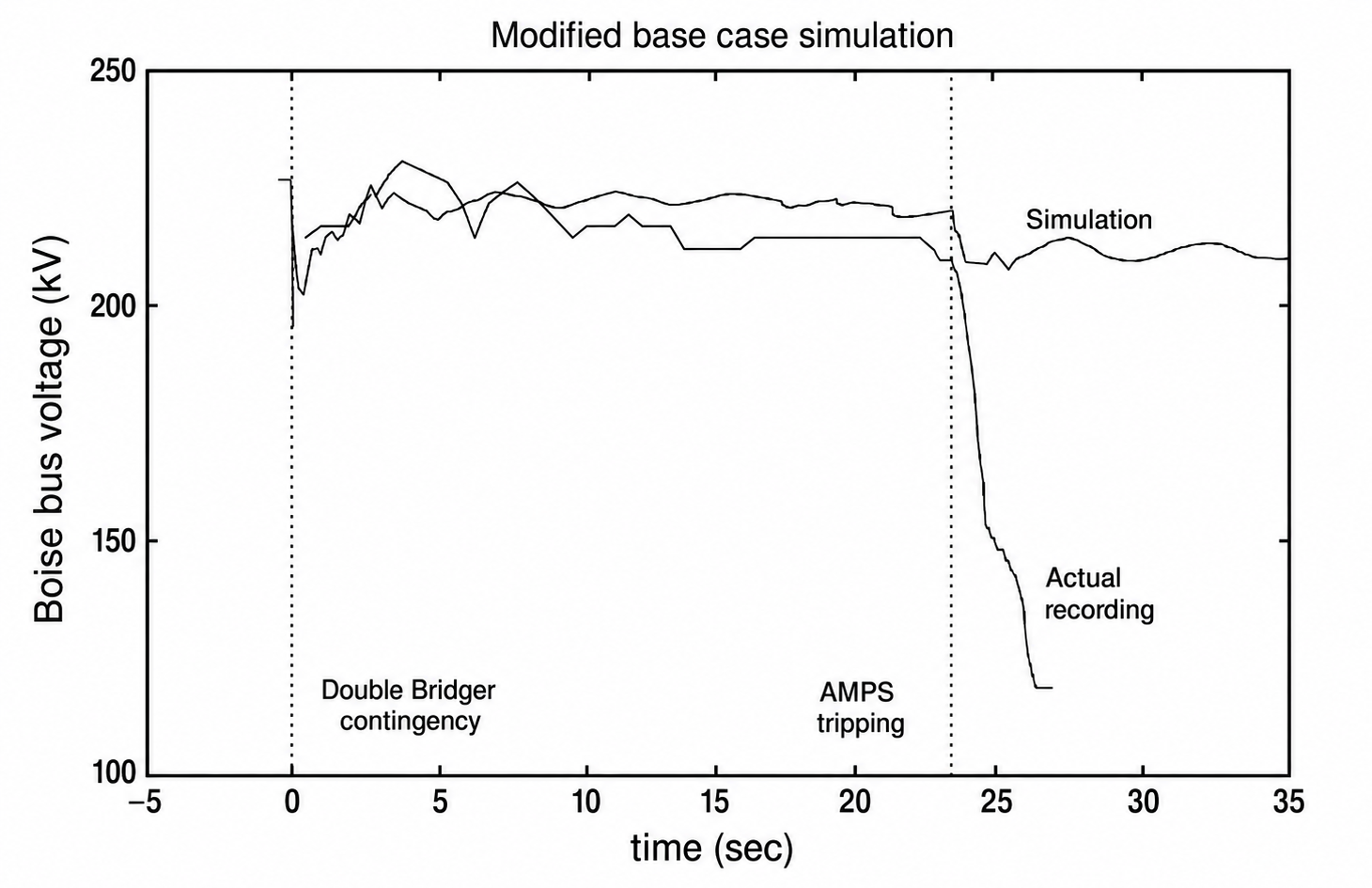
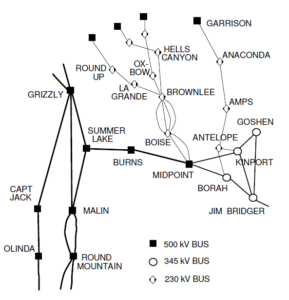
A fault on the 345 kV line between the Jim Bridger plant in Wyoming and Kinport in southeastern Idaho cleared correctly. A relay misoperation then opened the parallel line to Goshen, also in Idaho. The remedial action scheme performed exactly as designed, dropping two Bridger units, bypassing series capacitors and inserting shunt capacitors at Kinport, yet the Idaho area was still reactive deficient afterward. Twenty seconds later a Zone 3 relay tripped a 230 kV line, field current limiters on the Idaho Power system ran out of margin, and the Boise 230 kV bus fell from 210 kV to 150 kV in about three seconds. The system separated inside thirty seconds, faster than any operator could act.
August 10, 1996
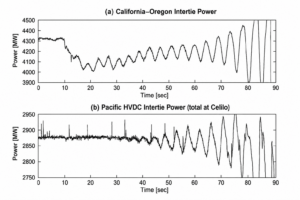
Two 500 kV lines were already on forced outage, and a transformer outage at Keeler in northwest Oregon had cut the 500 kV bus off from static var support at 230 kV. The Allston to Keeler 500 kV line, in the same area and carrying 1,300 MW, sagged into a tree. Parallel lower-voltage lines reached 115 percent of thermal rating. Thirteen units at McNary, on the Columbia River in Oregon, then tripped in sequence on exciter protection malfunctions at high field voltage. A pre-existing 0.25 Hz interarea mode went from near-zero damping to negative damping as AGC picked up generation upriver in Washington and Oregon. Seventy-five seconds after the 230 kV fault near Portland, the California to Oregon Intertie relayed out. The result was four islands, 30,390 MW of load lost, and 7.49 million customers out.
What the postmortems actually found
July was voltage instability and August was oscillatory instability, two different mechanisms with one finding in common.
The models the industry was using could not reproduce either event. Simulated with the standard WSCC dynamic database, the August 10 sequence produced a stable, well damped response while the real system oscillated its way to break-up. Matching the recordings took five changes: a detailed four-terminal model of the Pacific HVDC Intertie, representation of automatic generation control at Grand Coulee, Chief Joseph and John Day, blocking of turbine speed controls on large steam units, representation of high side voltage controls on the lower Columbia hydro plants, and dynamic load representation in place of constant current. The July 2 work needed its own additions: excitation over-current limiters on the Idaho units, induction motor content in the Idaho load, and governor blocking on thermal units above 100 MW.
The equipment behavior that decided both outcomes was missing from the models, and none of the physics involved was exotic. The representations had simply not kept pace with what was installed and how it was set.
What 1996 produced
Sound engineering came quickly, and then a long wait. Validation work by BPA and other stakeholders settled the physics within two years. WSCC, now WECC, stood up a contract-based reliability management system in 1997 that became the first regional standards in the West, a history still recorded in the introduction to FAC-501-WECC. A national obligation didn’t arrive for another decade. That took the August 14, 2003 cascade, EPAct 2005, and mandatory enforceable Reliability Standards in 2007.
The published discussion of the August 10 validation work put the harder version on the record. Every technical problem identified after the breakup had already been reported to the region in earlier years, along with the countermeasures eventually adopted. The region already had the knowledge. What it lacked was a mechanism to act on it.
The engineering was settled by 1998. The obligation to act on it arrived in 2007. The gap between those two dates is the lesson.
The same gap, three decades later
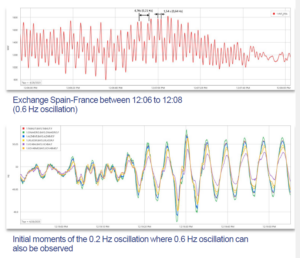
Europe’s grid operators published their final report on the April 28, 2025 Iberian blackout in March. Different mechanism, same shape. What was being connected to that system changed faster than the ability to analyze what those changes would do under stress. The recommended actions include a framework for damping interarea oscillations, wider deployment and tuning of power system stabilizers, HVDC power oscillation damping, and high quality real time measurement to detect and localize oscillations. Set that list beside what the West adopted after August 10, 1996, and it is close to the same list.
PJM has already been through the intermediate version of this. The same ride-through problem appeared with inverter-based generation, whose inverters were set to disconnect during minor disturbances, and PJM and its stakeholders approved voluntary ride-through guidelines for those resources in 2019. The challenge is now arriving on the load side.
On July 22, 2026, at 7:56 a.m., a mechanical failure removed a 230 kV line from service in northern Virginia. The fault was properly cleared. Data centers in the Dominion zone then disconnected without warning, a first wave of 2,970 MW followed by a second of 1,099 MW. PJM observed load fall from 99,984 MW to 96,205 MW, roughly 3,800 MW in total, and dispatched generation down to restore frequency to 60 Hz. It was the largest event of its kind in PJM’s history. Both voltage and frequency moved, though the wide area effect was frequency. The high voltage was local, arising as the loads transferred away.
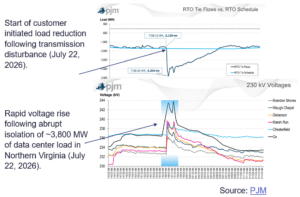
Nothing on the transmission system misoperated. The behavior that mattered sat inside private facilities, in protection settings that predate any requirement to ride through, and system models have not necessarily kept up.
That is why so much of NERC’s large loads work is aimed at complete and accurate models of computational load behavior. Computational loads are not presently subject to NERC Reliability Standards and are not a registered entity. FERC changed that trajectory on July 16, 2026, directing NERC in Docket RD26-7-000 to develop mandatory standards for the integration of computational loads and registration criteria for computational load entities, with the first phase due December 31, 2026. Voltage and frequency ride-through requirements are expected in standards in 2027 rather than in that first phase. Six days after the FERC order, 3,800 MW left the system in northern Virginia. In August, PJM said it is considering interconnection reliability requirements for computational loads, ride-through among them. The NERC Level 3 Essential Actions Alert issued May 4, 2026 already put the modeling obligation in front of registered entities.
How does Danovo Energy Solutions fit in?
Danovo Energy Solutions supports transmission owners, planners and large load developers on the studies that expose this class of risk:
- Planning and extreme event assessment under TPL-001, including whether a sequence produces instability, uncontrolled islanding or cascading
- Voltage stability and electromechanical oscillation assessment, including positive-sequence modal analysis and damping margin studies
- EMT studies for converter control interaction, subsynchronous oscillation and weak-grid performance
- Protection and control interaction review across PRC-019, PRC-023, PRC-024 and PRC-026
- Dynamic model data and validation under MOD-032 and MOD-033, including as-built and hardware-in-the-loop verification
- STATCOM and FACTS application for voltage control and damping at gigawatt-scale interconnections
The team is also engaged in NERC’s large loads work, including the Large Loads Working Group white paper on computational load disturbance performance, and continues to support registered entities responding to the Level 3 Alert and the standards development in Project 2026-02.
Related Reading
Sources
In Summary
Defense in depth was the conclusion the 1996 investigators reached, and it still is. The harder lesson is the one the record keeps repeating. Problems get identified, reported, and then left in the file. Most planners have a version of that file on their own system.